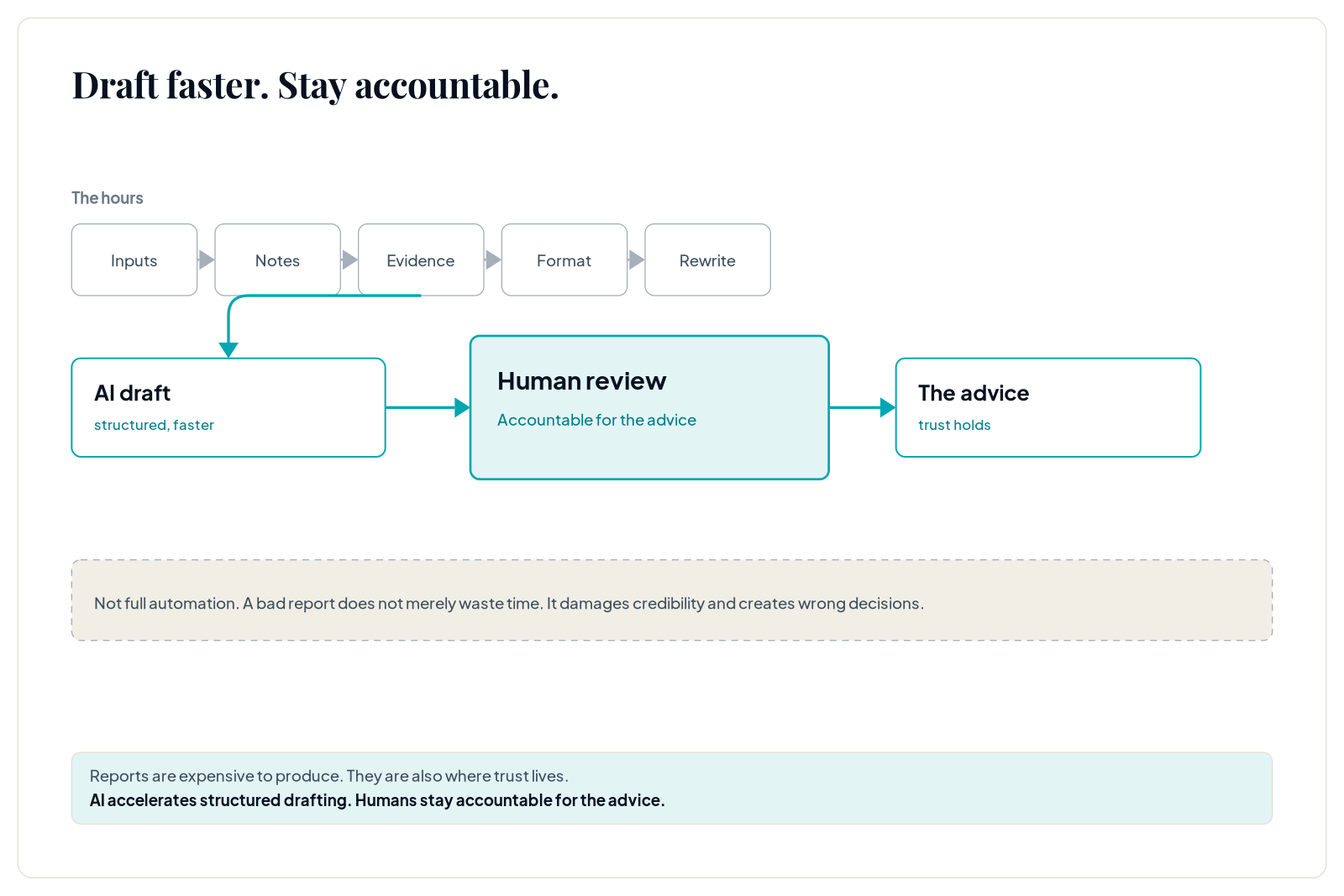
AI report generation is attractive because reports are expensive to produce. Teams spend hours collecting inputs, reading notes, summarizing evidence, formatting sections, and rewriting similar recommendations across clients.
But reports are also where trust lives. A bad report does not merely waste time. It damages credibility, creates wrong decisions, and makes the team look careless.
The right approach is not full automation. The right approach is a reviewed workflow where AI accelerates structured drafting and humans stay accountable for the advice.
Start With the Report's Job
Before adding AI, define what the report is supposed to do. Is it a diagnostic? A compliance summary? A client recommendation? A board update? A sales follow-up? A clinical or financial decision support document?
The job determines the review standard. A low-stakes internal summary can tolerate more automation. A client-facing strategic recommendation needs stronger evidence, traceability, and human sign-off. A regulated or safety-sensitive report may need strict controls and audit trails.
AI does not remove that distinction. It makes the distinction more important.
Break the Workflow Into Stages
AI report systems work best when the workflow is broken into stages instead of one large prompt.
A practical flow might include intake, data cleaning, evidence extraction, section outline, first draft, citation or evidence attachment, reviewer comments, final edits, approval, and delivery.
Each stage should have a clear owner and a clear quality check. AI can summarize interview notes, classify responses, draft sections, identify missing inputs, and suggest recommendations. Humans should review evidence quality, resolve contradictions, adjust judgment, and approve the final report.
Design the Human Review Layer
Human review should not mean someone glances at a generated document at the end.
A useful review layer tells the reviewer what changed, what evidence supports each claim, which sections are AI-generated, which fields are low confidence, and where source material is missing or contradictory.
The reviewer should be able to accept, edit, reject, and annotate. The system should preserve the final decision, not just the AI draft.
Avoid the Generic Report Trap
The easiest AI report to generate is also the least valuable: a polished, generic document that sounds confident but could apply to anyone.
To avoid that, the workflow needs structured inputs and reusable logic. It should know the client profile, assessment answers, evidence, scoring model, benchmark, constraints, and recommended actions. The more precise the inputs and rules, the less generic the output becomes.
Good AI report systems are not just writing systems. They are methodology systems.
Keep Evidence Close to the Claim
For expert reports, every important claim should be traceable to a source: an interview answer, uploaded document, form response, spreadsheet value, assessment score, or reviewer note.
That does not mean every sentence needs a formal citation. It means the reviewer should know why the system said what it said.
This is where many AI experiments fail. They generate a report, but the team cannot quickly verify the reasoning. If verification takes longer than writing from scratch, the workflow will not survive.
Use AI Where It Has Leverage
AI is usually strongest in report workflows when it handles summarization, structuring, comparison, tone normalization, first-draft writing, missing-information detection, and recommendation assembly from a reviewed library.
It is weaker when asked to invent strategy from vague inputs or make final calls without context.
The most practical systems pair AI drafting with a human-owned recommendation library. AI assembles and adapts. Experts decide what the library should contain and when it applies.
What Karao Would Scope First
Karao would start by mapping the current report process: inputs, templates, repeated sections, decision rules, review steps, source material, approval path, and delivery format.
The first build might be an internal report assistant rather than a client-facing AI product. It could collect structured inputs, produce a draft, attach source references, flag missing data, and route the report for expert review.
That first version proves the workflow safely. Once quality and review behavior are stable, the system can become more automated or client-facing.
Practical Checklist
Before building, define report type, input schema, evidence sources, section structure, AI-owned tasks, human-owned tasks, confidence flags, approval rules, and audit needs.
If the team cannot explain who is accountable for each section, the workflow is not ready for automation.