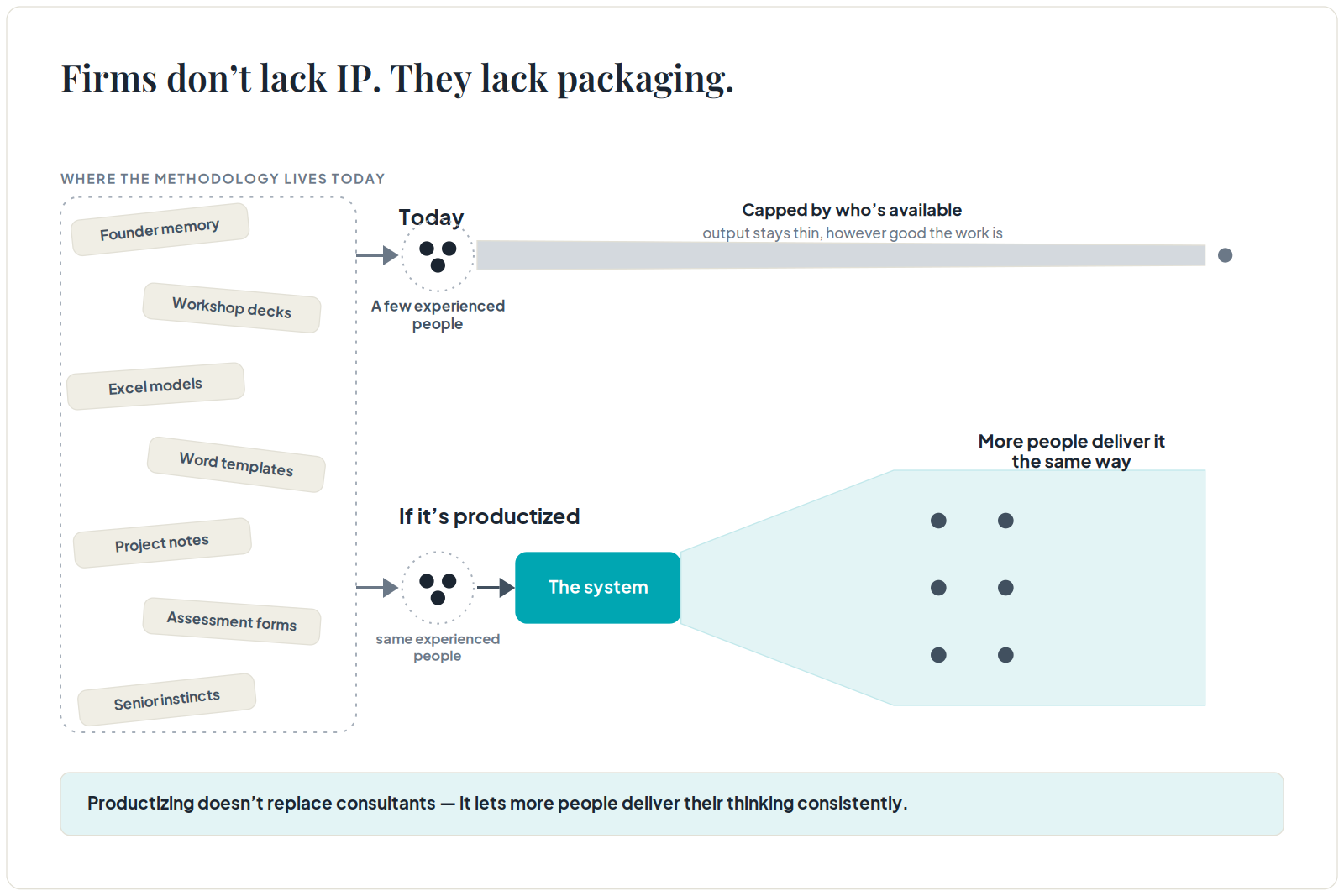
Most consulting firms do not lack intellectual property. They lack packaging.
The methodology is there, but it lives across founder memory, workshop decks, Excel models, Word templates, project notes, assessment forms, and senior consultant instincts. Clients value the work, but delivery depends heavily on a small number of experienced people.
Productizing methodology is not about replacing consultants. It is about turning the repeatable part of the firm's thinking into a system that more people can use consistently.
Do Not Start by Building a Platform
A common mistake is deciding, too early, that the firm needs a SaaS product. That creates pressure to define dashboards, logins, AI features, subscriptions, and client portals before the firm has clarified what exactly is repeatable.
The first step is not platform design. The first step is methodology extraction.
The firm needs to identify the inputs it collects, the questions it asks, the patterns it looks for, the scoring logic it applies, the recommendations it gives, and the human judgment it refuses to automate.
Separate Expertise From Delivery Ritual
Consulting work often contains two very different layers. One layer is the unique expertise: diagnosis, synthesis, framing, tradeoff decisions, and client-specific judgment. The other layer is delivery ritual: intake forms, repeated questions, scorecards, workshop prompts, templates, report sections, checklists, and follow-up actions.
Productization usually starts with the delivery ritual. This is where the firm can create leverage without cheapening the expertise.
A diagnostic platform, assessment engine, client portal, report generator, or internal analyst tool can standardize the repeatable path while still leaving the consultant in control of final interpretation.
Map the Method as a Decision System
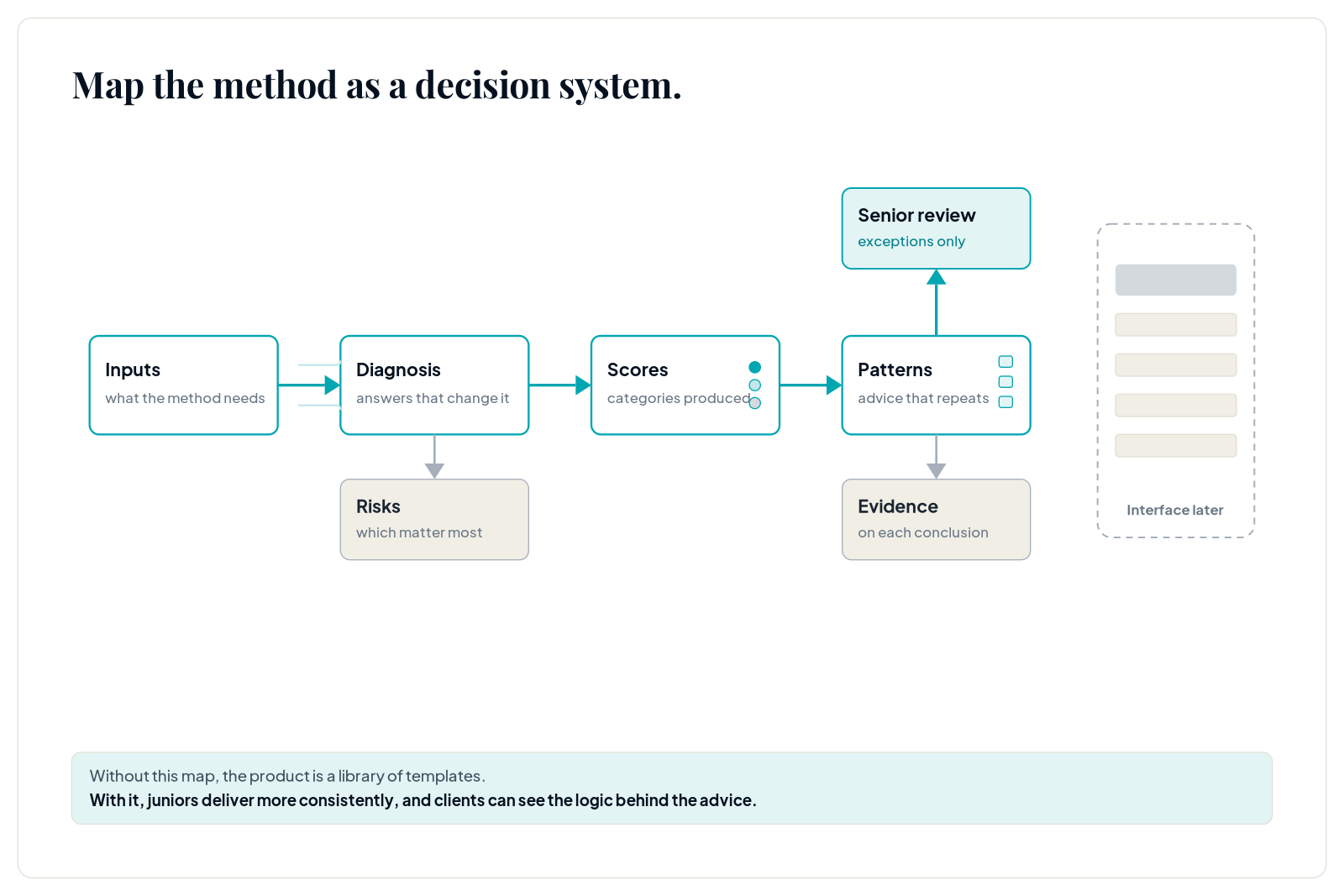
A methodology becomes productizable when it can be expressed as a decision system.
What inputs are required? Which answers change the diagnosis? Which risks matter most? What scores or categories are produced? What recommendation patterns repeat? Which exceptions need senior review? What evidence should be attached to each conclusion?
This map is more important than the interface at first. Without it, the product becomes a library of templates. With it, the firm can build a tool that helps junior teams deliver more consistently and helps clients see the logic behind the advice.
Choose the First Product Surface
The first product surface depends on where the firm feels the bottleneck.
If partners spend too much time qualifying clients, the first product may be a diagnostic intake. If delivery quality varies across teams, it may be an internal assessment tool. If clients struggle to understand recommendations, it may be a report generator with human review. If the firm wants a scalable offer, it may be a paid self-assessment that leads into advisory work.
The point is to productize one repeatable moment, not the whole firm.
Protect the Human Judgment Layer
The worst productized methodology feels like a quiz pretending to be strategy.
Strong firms avoid that by being explicit about what the system can and cannot decide. The product can collect inputs, apply rules, surface patterns, generate first-draft recommendations, and create a structured report. The consultant should still own exceptions, context, sensitive interpretation, and final advice.
That boundary is especially important when AI is introduced. AI can help draft, classify, summarize, and compare. It should not silently become the firm's senior judgment.
Turn IP Into Operating Assets
A productized methodology usually creates several operating assets: a question bank, scoring model, evidence schema, recommendation library, report structure, review workflow, client record, and improvement loop.
These assets matter because they move the firm away from one-off delivery. Every engagement can improve the methodology. Every review can sharpen the recommendation library. Every client outcome can make the diagnostic model more useful.
That is how the product becomes more than a digital wrapper around consulting.
What Karao Would Scope First
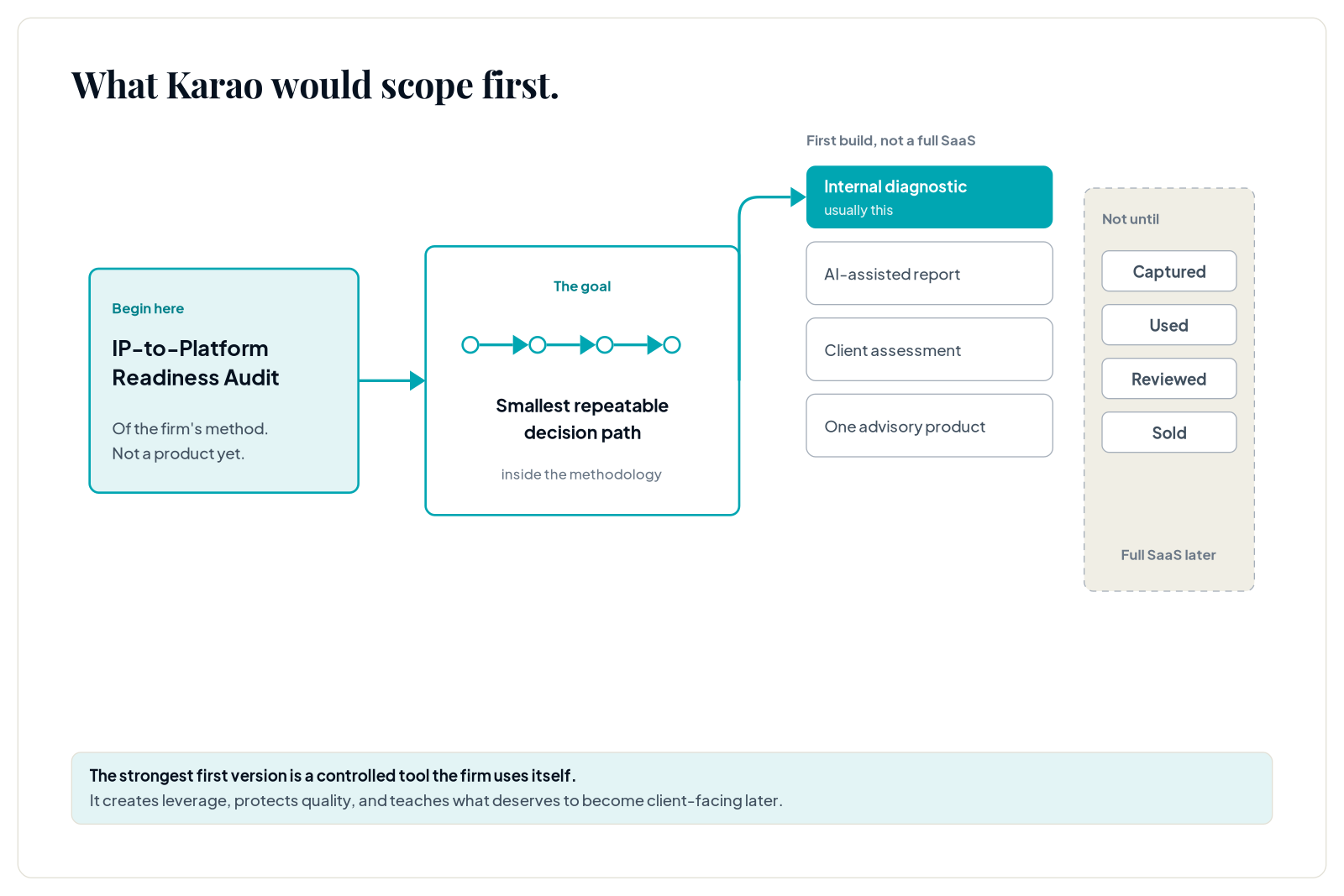
Karao would begin with an IP-to-Platform Readiness Audit. The goal would be to find the smallest repeatable decision path inside the firm's methodology.
From there, the first build might be an internal diagnostic tool, an AI-assisted report workflow, a client-facing assessment, or a lightweight platform for one advisory product. The firm should not build a full SaaS product until it has proven that the methodology can be captured, used, reviewed, and sold in a repeatable way.
The strongest first version is usually a controlled tool used by the firm itself. It creates leverage, protects quality, and teaches the team what deserves to become client-facing later.
Practical Checklist
Before building, document the methodology's inputs, scoring rules, decision points, recommendation patterns, evidence standards, human review steps, and client-facing output.
If those pieces are visible, the firm has something to productize. If they are still trapped in partner memory, the first work is extraction, not software.