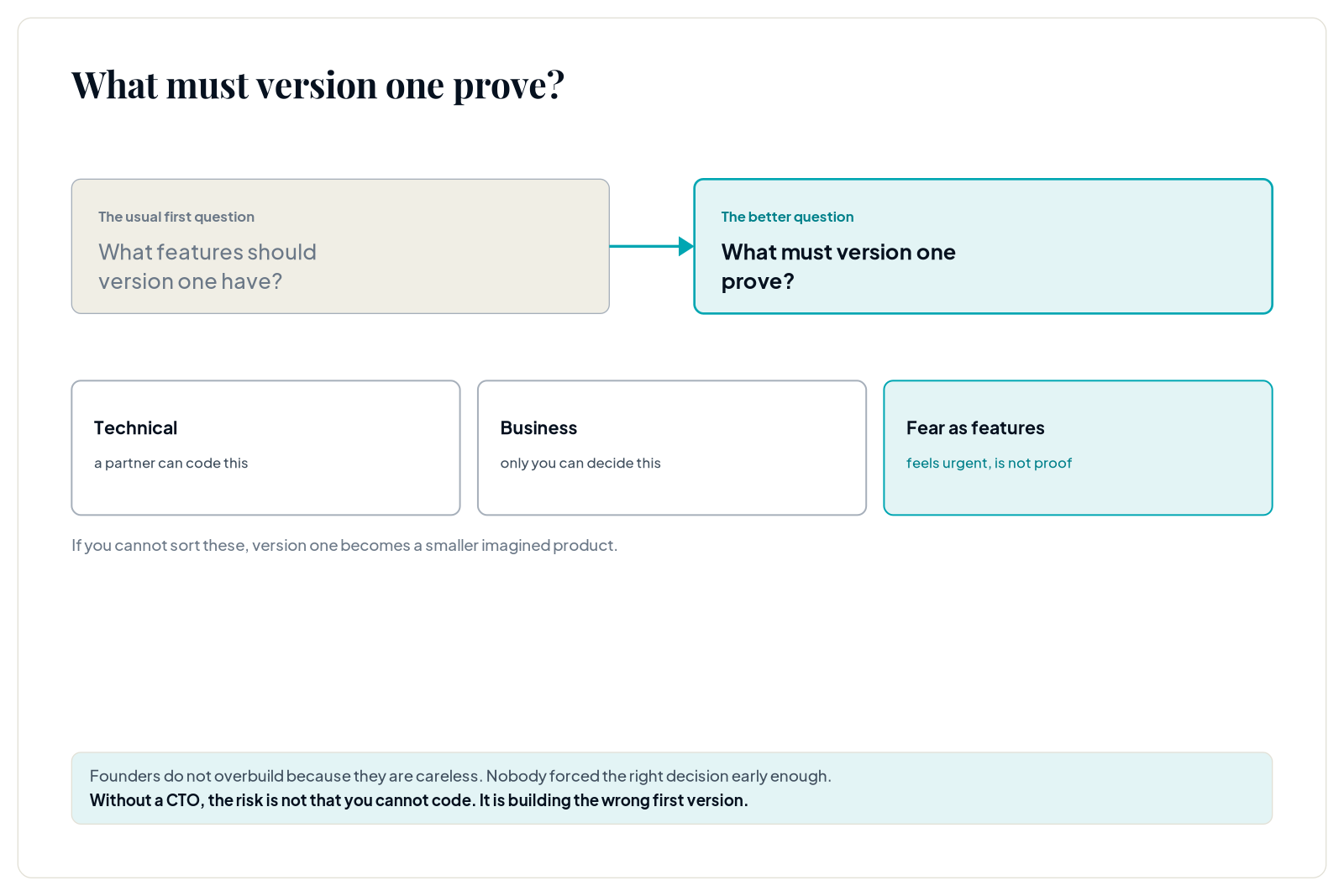
Most founders do not overbuild their MVP because they are careless. They overbuild because nobody has forced the right decision early enough.
If you do not have a CTO, the risky part is not that you cannot code. The risky part is that you may not know which product decisions are technical, which are business decisions, and which are just fear disguised as features.
This is where MVP scoping usually goes wrong. Founders start by asking, "What features should version one have?" That sounds practical, but it is the wrong first question.
The better question is: what must version one prove?
An MVP Is Not a Smaller Version of the Final Company
The phrase minimum viable product has been repeated so many times that it has lost some of its usefulness. People hear "minimum" and think cheap. They hear "viable" and think barely usable. They hear "product" and think a list of features.
That framing creates bad software.
A real MVP is not a miniature version of the company you hope to build in three years. It is the smallest useful product loop that can teach you whether the user, problem, workflow, and business case are real enough to keep investing.
That distinction matters. If you are building a marketplace, the MVP does not need every future buyer and seller tool. It needs to prove that supply can be onboarded, demand can be captured, a transaction can happen, and the team can see what is going on. If you are building an AI workflow product, the MVP does not need a complete automation suite. It needs to prove that the output is valuable, repeatable, and trusted enough for a user to come back.
The first version should prove the operating loop, not imitate the final company.
Start With the Signal You Already Have
Founders often say, "I have an idea," when they actually have something more useful than an idea. They may have investor interest, customer conversations, a waitlist, a deck that keeps getting forwarded, a manual service, a spreadsheet workflow, or a no-code prototype that is starting to break.
Those signals are not equal.
A deck is a signal of narrative clarity. Conversations are a signal of problem interest. A waitlist is a signal of intent. A manual workflow is a signal of behavior. Paid or repeated manual usage is the strongest signal because it shows that someone is already trying to get the outcome, even without proper software.
Your MVP scope should change depending on the signal you have. If all you have is a deck, you probably need a sharper promise and prototype before a full build. If you have conversations and a waitlist, you may be ready to scope the first product loop. If people are already using a manual workaround with you, the MVP can focus on turning that repeated workflow into software.
This is why copy-paste MVP checklists are dangerous. They ignore the maturity of the founder's evidence.
Choose One User, Not a Market
The fastest way to ruin an MVP scope is to describe the user too broadly.
"Small businesses" is not a first user. "D2C brands" is not a first user. "Students" is not a first user. These are markets, not build instructions.
A useful MVP user sounds more specific: a clinic owner who manages appointments over WhatsApp; a marketplace operator onboarding the first 25 vendors; a product research team that needs to turn interview notes into decisions; a consultant who wants to turn a diagnostic framework into a repeatable client report.
Specific users create specific workflows. Specific workflows create scope. Vague users create feature lists that never end.
If you cannot name the first user clearly, do not start by building. Start by narrowing.
Map the First Workflow End to End
Once the first user is clear, map the workflow. Not the app. Not the dream product. The workflow.
What starts the process? What information does the user provide? What action do they need to complete? What decision happens in the middle? What output do they expect? Who needs to be notified? What must be tracked? What happens if something goes wrong?
This is where non-technical founders often discover that the feature list was hiding the real product. A booking MVP is not just a calendar screen. It may need enquiry capture, service selection, slot rules, confirmation messages, payment status, reminders, cancellation handling, and an owner view. Some of that should be software. Some of it can stay manual. But you cannot make that decision until the workflow is visible.
A workflow map also helps you speak to developers, designers, investors, and early users without hand-waving. It turns "I want an app like X" into "this is the first loop we need to prove."
Decide What Can Stay Manual
This is the part founders resist, but it is often where the budget is saved.
Manual work in version one is not failure. It is a scoping tool. If a task is rare, operationally complex, or not central to the proof target, it can often stay manual until the product earns the right to automate it.
For example, you may not need automated vendor approval in the first marketplace MVP. The founder can approve vendors manually. You may not need a full AI report editor in the first diagnostic product. The team can review and polish outputs manually. You may not need a complex dashboard in the first launch. A simple admin table and event tracking may be enough.
The question is not "Can this be automated?" Of course it can. The question is "Does automating this help us prove the MVP faster?"
If the answer is no, it waits.
Use Four Risks to Pressure-Test Scope
When a founder does not have a CTO, they usually think the missing risk is technical feasibility. That is only one risk.
A good MVP scope has to survive four questions.
- Value: will the user care enough to use it, pay for it, recommend it, or change behavior?
- Usability: can the user understand and complete the workflow without founder hand-holding?
- Feasibility: can this be built with the available time, budget, tools, integrations, and team skill?
- Viability: does this version make sense for the business model, sales path, operations, legal constraints, and future roadmap?
This matters because founders often solve one risk while ignoring the others. A beautiful prototype may reduce usability risk but tell you nothing about feasibility. A technically impressive build may still fail value risk. A strong user workflow may still be commercially weak if the business model does not work.
The MVP scope should focus on the riskiest assumption, not the most exciting feature.
Set the Appetite Before the Feature List
One of the most useful ideas from product scoping is fixed time, variable scope. Decide the appetite first: how much time, money, and attention is this first version worth?
That sounds uncomfortable, especially for founders who want an exact estimate. But estimates become messy when the product is still fuzzy. Appetite creates a boundary. It forces trade-offs.
A founder might say, "We want to spend six weeks proving whether vendors and buyers can complete the first transaction flow." That is a much better scoping anchor than "How much will it cost to build the platform?"
With an appetite in place, the conversation changes. Instead of asking whether every feature is useful, you ask whether it belongs inside this proof window.
Create a Scope You Can Defend
By the end of scoping, you should have a document that a developer can build from, an investor can understand, and a founder can defend.
It does not need to be a 40-page PRD. In fact, at MVP stage, a shorter document is usually better. But it does need to answer the questions that prevent scope creep.
- Who is the first user?
- What painful problem are we solving first?
- What is the first workflow from start to finish?
- What must version one prove?
- What features are launch-critical?
- What can stay manual?
- What is explicitly out of scope?
- What metrics or user behaviors will tell us whether the MVP worked?
- What budget and timeline boundaries are real?
- What happens after launch if the signal is strong, weak, or confusing?
This is the point where developer conversations become safer. You are no longer asking someone to price a dream. You are asking them to build a bounded first version around a clear product loop.
Beware of Investor Theatre
Some features exist only because the founder is imagining an investor demo. That is not always wrong, but it should be named honestly.
Investor-facing polish can matter if fundraising is the immediate constraint. A clickable prototype, clean onboarding flow, or simple traction dashboard may help tell the story. But if those things do not help users complete the core workflow, they should not silently consume the MVP budget.
There is a difference between building proof and building theatre. Both can have a place. Confusing them is expensive.
What Usually Belongs in Version One
Every product is different, but early MVPs usually need a few practical pieces.
They need a way for the user to enter the product, complete the core action, receive the promised output, and give the founder enough visibility to learn. That may mean onboarding, authentication, a simple workflow, basic admin, notifications, analytics, deployment, and a feedback loop.
What usually waits? Advanced dashboards, complex role systems, referral engines, multi-language support, subscriptions, deep integrations, full AI automation, mobile apps, and edge-case handling that only matters at scale.
Again, none of these are bad. They are just not automatically version one.
What Karao Would Look For Before Building
For Karao, a build-ready MVP does not mean the founder has every answer. It means the important unknowns are visible enough to make a smart first bet.
The useful inputs are simple: your deck, notes from user conversations, waitlist data, screenshots of the manual process, spreadsheet examples, rough budget, target launch date, and a clear explanation of what happens today without the product.
From there, the job is to turn founder judgment, user evidence, workflow risk, and budget reality into a product loop, phased scope, and launch path.
This is also why a founder may need a clarity sprint before a build. Sometimes the best technical decision is to not build yet. Sometimes it is to prototype. Sometimes it is to build the narrow workflow. Sometimes it is to keep the backend manual and put a usable front-end in users' hands.
The answer depends on the proof target.
The Real Job of a No-CTO MVP Scope
You do not need a CTO to make the next smart product decision. You do need a way to separate evidence from excitement, proof from polish, and core workflow from future roadmap.
That is the real job of MVP scoping.
If you have interest, conversations, a deck, a waitlist, or a manual prototype, the next step is not to ask for a vague development estimate. The next step is to decide what the first version must prove, what can stay manual, and what scope is worth building now.
Build that version. Learn from it. Then earn the next version with evidence.
Practical Next Step
If you are not sure whether your MVP is build-ready, start by scoring the basics: first user, validation signal, workflow clarity, proof target, constraints, and manual boundaries.
That is exactly what Karao's MVP Readiness Scorecard is designed to surface. High-fit founders can move into a founder strategy call or Prototype-to-Launch Build. Medium-fit founders usually need an MVP Clarity Sprint. Low-fit founders should tighten validation before spending on a full build.
The point is not to slow you down. It is to make sure the first money you spend on product development creates learning, not regret.