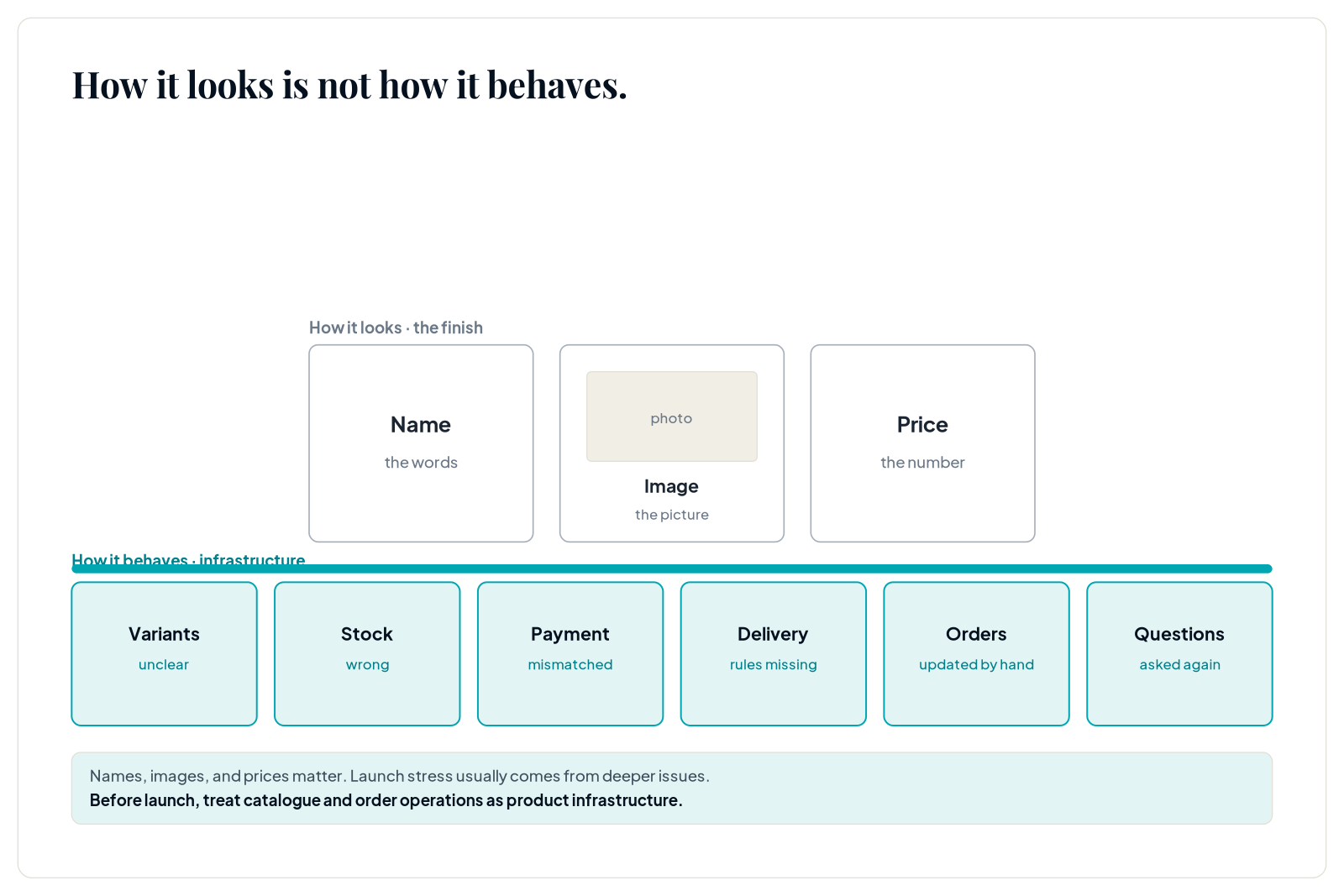
Commerce launches often spend too much time on how the catalogue looks and not enough time on how the catalogue behaves.
Product names, images, and prices matter. But launch stress usually comes from deeper issues: unclear variants, wrong stock, mismatched payment status, missing delivery rules, manual order updates, and customers asking the same questions repeatedly.
Before launch, catalogue and order operations need to be treated as product infrastructure.
Define the Catalogue Rules
A catalogue is not just a list of items. It is a set of selling rules.
Each product needs a name, description, price, availability rule, variant structure, media, delivery promise, return or cancellation rule, and support answer for common questions. If a product is made-to-order, limited stock, location-specific, seasonal, bundled, or customizable, that rule must be visible before customers start buying.
If staff have to interpret the catalogue differently for every order, the launch will become manual support.
Keep the First Catalogue Smaller Than You Want
A smaller catalogue is easier to test, fulfil, support, and improve.
Many teams launch with too many SKUs because breadth feels impressive. But every extra item adds stock questions, content work, variant handling, fulfilment rules, and support risk.
The first catalogue should include the products that prove demand and can be fulfilled reliably. Expansion can happen after the team understands what customers choose, what they ask, and where operations break.
Design the Order Status Flow
Order status is the backbone of commerce operations.
A simple first flow might include new, awaiting payment, paid, preparing, shipped or ready, delivered, cancelled, refunded, and support needed. The exact statuses depend on the business, but the team must agree on what each status means and who updates it.
Without status discipline, customers ask for updates, staff repeat work, and the owner loses visibility.
Connect Payment to Order Reality
Payment screenshots, manual bank checks, and chat confirmations can work at low volume. They become risky when orders increase.
The team should decide how payment is requested, how it is confirmed, what happens when payment is pending, how failed payments are handled, and when an order can move into fulfilment.
The key is not always full automation. The key is one visible payment truth that the team trusts.
Prepare the Support Layer
Every catalogue creates questions. Is this available? What size should I choose? Can it be delivered today? What is the return policy? Can I customize it? Has my order shipped?
Before launch, the team should prepare standard answers, quick replies, FAQs, and escalation rules. Support should feed back into catalogue improvement. If ten people ask the same question, the catalogue probably needs clearer information.
Good catalogue operations reduce support load by answering predictable questions before they reach chat.
Plan Fulfilment Before Marketing
Marketing can create demand faster than operations can absorb it.
Before launch, define who receives the order, who checks stock, who packs or prepares, who updates status, who contacts the customer, who handles exceptions, and what the owner sees at the end of the day.
If those roles are unclear, a successful launch will feel like a crisis.
What Karao Would Scope First
Karao would start with the catalogue-order-payment-fulfilment loop. The first work would be to define product rules, order stages, payment visibility, fulfilment ownership, support patterns, and repeat purchase triggers.
From there, the build could be a commerce backend, Shopify setup, WhatsApp order flow, payment-link system, inventory workflow, or owner dashboard. The technology choice should follow the operating loop.
A launch is not ready because the products are uploaded. It is ready when the team can sell, confirm, fulfil, support, and learn from orders without rebuilding the process every day.
Practical Checklist
Before launch, finalize product rules, variant rules, stock rules, pricing, delivery promises, payment confirmation, order statuses, fulfilment ownership, support replies, cancellation rules, and reporting needs.
If these decisions are not visible, postpone the launch or reduce the catalogue.