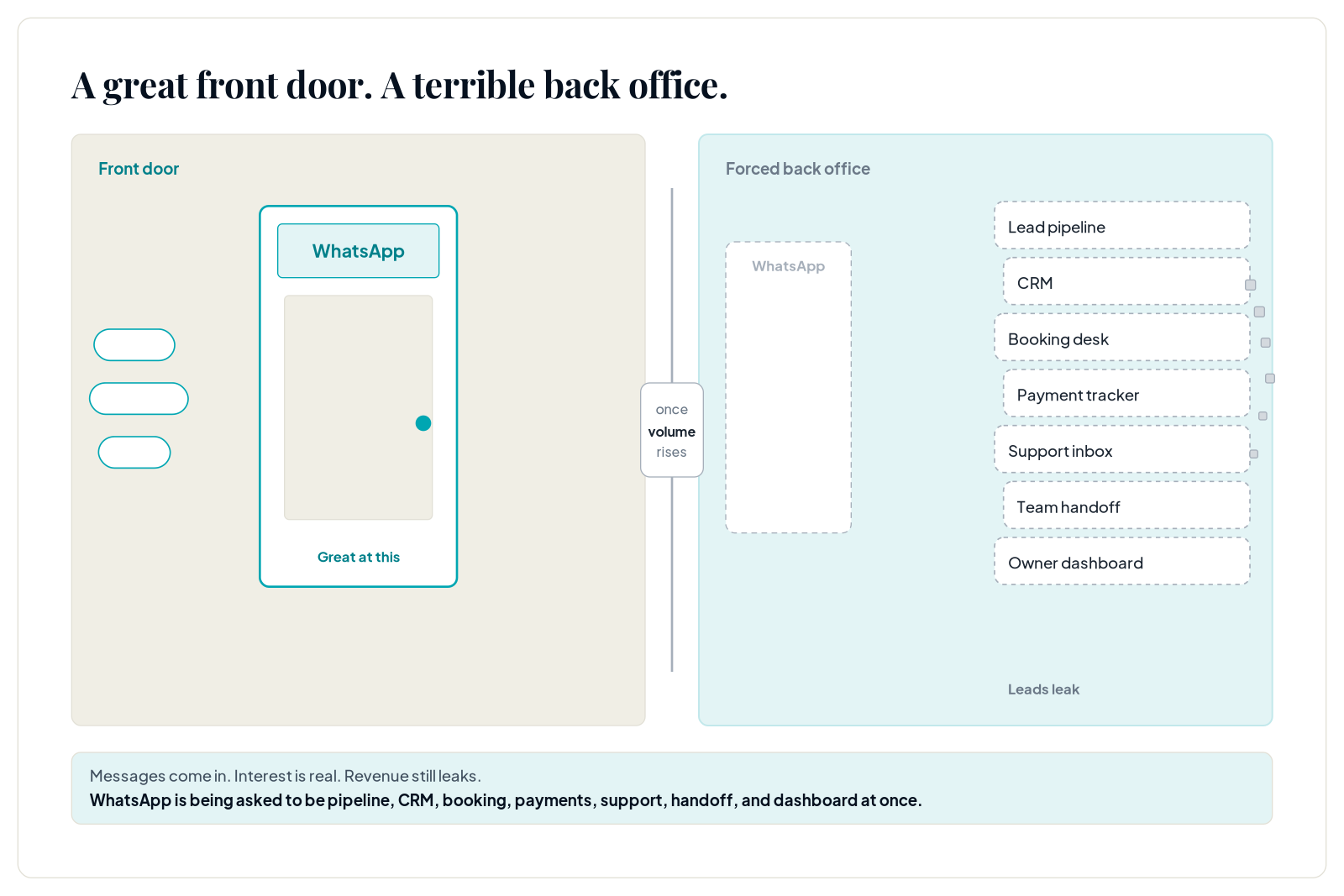
WhatsApp is a great front door for a business. It is a terrible back office.
That is the uncomfortable truth behind a lot of owner-led businesses that feel busy but still lose leads. The messages are coming in. Customers are asking questions. People are showing interest. But somehow the revenue does not match the demand.
The problem is usually not WhatsApp itself. The problem is that WhatsApp is being forced to act as the lead pipeline, CRM, booking desk, payment tracker, support inbox, team handoff system, and owner dashboard all at once.
That just does not work once volume increases.
A Reply Is Not the Same as Lead Capture
The first mistake WhatsApp-first businesses make is assuming a lead has been captured because someone replied.
It has not.
A lead is not truly captured until the business knows where the enquiry came from, what the customer wants, who owns the next step, what status the lead is in, when to follow up, and what has to happen for the customer to book, pay, or buy.
This matters because a fast reply can still lead nowhere. A customer asks for price. Someone replies. The customer says, "Okay, I will confirm." Then the chat gets buried under fifty other messages and no one remembers to follow up.
That lead did not reject the business. The system lost the lead.
The First Leak Is Ownership
The lead is not lost when the customer says no. It is lost when nobody knows what should happen next.
In a small business, this often starts innocently. The owner handles some chats. A staff member handles others. Someone replies from the business phone. Someone else responds from Instagram. A referral comes directly to the owner. A walk-in asks a question and then sends a WhatsApp message later.
At low volume, memory carries the business.
At higher volume, memory becomes the bottleneck. No one knows which enquiries were new, which were hot, which were waiting for a quote, which needed a reminder, which had paid, and which had quietly gone cold.
The fix is not complicated, but it does require discipline. Every enquiry needs an owner. Not eventually. Immediately.
The Second Leak Is Status
A WhatsApp chat thread is not a pipeline.
It may show the conversation, but it does not reliably show the state of the sale. Is this person just asking? Are they ready to book? Did they receive the payment link? Did they pay? Are they waiting for availability? Did someone promise to call back? Did they cancel? Should they be contacted again next month?
If the team has to scroll through messages to answer those questions, the lead system is already leaking.
Status is what turns a message into an operating flow. New enquiry. Qualified. Quote sent. Waiting. Booked. Payment pending. Paid. Delivered. Follow-up due. Lost. Repeat potential.
Without status, every lead depends on whoever happens to remember the conversation.
The Third Leak Is Follow-Up
This is where a lot of revenue disappears quietly.
The customer did not say no. They just did not reply. The business did not follow up because there was no reminder, no owner, no stage, and no rule for what should happen next.
The real kicker is that follow-up failure usually feels like low demand. Owners say, "People enquire but do not convert." Sometimes that is true. But many times, people enquired, got a partial answer, asked one more question, delayed the decision, and then disappeared because the business had no follow-up rhythm.
A fast first reply is useful. A visible next action is what protects revenue.
This is especially important when the business is spending on ads. If paid traffic brings WhatsApp enquiries but the follow-up process is manual, the business is paying to create leakage.
The Fourth Leak Is Booking and Payment Visibility
Bookings and payments are where WhatsApp businesses often look functional from the outside and chaotic on the inside.
A customer asks for a slot. Someone checks availability. A time is suggested. A payment link is sent. The customer sends a screenshot. Someone confirms manually. Later, the owner has to check whether the payment was actually received. Then the appointment or order has to be remembered somewhere else.
That is not a system. That is coordination by scrolling.
The same thing happens with product sellers. Availability is confirmed in chat. Payment happens through UPI or a link. The customer asks about delivery. The order status lives in the conversation, the payment status lives in someone else's memory, and fulfilment lives in a sheet.
This is how businesses lose money without seeing it clearly. Payments are pending, bookings are duplicated, customers need reminders, and the owner only finds out when someone complains.
The Fifth Leak Is Customer Memory
WhatsApp makes it easy to have a conversation. It does not automatically create customer memory.
That distinction matters.
A returning customer should not be treated like a stranger every time. The business should know what they asked about, what they bought, whether they paid on time, what service they used, what preferences they have, when they should be followed up with, and what offer or reminder makes sense next.
When that history is buried in old chats, repeat revenue becomes accidental.
This is one of the most expensive hidden costs of WhatsApp-first operations. The business may be getting demand, but it is not building memory. Without memory, every sale starts from zero.
A Chatbot Is Not the First Fix
Now let's talk about automation, because this is where many businesses jump too quickly.
A WhatsApp bot can be useful. Quick replies can be useful. Away messages can be useful. AI summaries can be useful. But automation only helps when the workflow is already clear.
If the business does not know how enquiries should be captured, who owns each lead, what statuses matter, when follow-up should happen, how payment should be tracked, or what the owner needs to see, a chatbot simply automates confusion.
The first fix is usually not a bot. The first fix is the operating flow behind the chat.
Once that flow is clear, automation becomes much more valuable. Repeated questions can become quick replies. Follow-ups can become reminders. Payment confirmation can update status. Customer notes can feed a CRM. Owner dashboards can show what is actually happening.
Different Businesses, Same Leak
The visible business changes, but the leakage pattern is often the same.
A clinic or studio loses leads when enquiries do not turn into confirmed slots, reminders, payments, visits, and repeat follow-ups. A local service business loses leads when enquiry, qualification, quote, follow-up, payment, and delivery are split across chats and memory. A D2C or catalogue seller loses leads when product questions, stock, payment links, order status, support, and repeat purchase prompts are scattered across threads.
Hospitality businesses see the same thing with availability, deposits, confirmations, cancellations, and reminders. Agencies see it with enquiry source, budget, scope, quote status, payment, and handoff.
The industry changes. The operating problem does not.
The business needs to know who came in, what they need, who owns it, whether they paid, and what happens next.
Before Spending More on Ads, Fix the Path
This is the part many owners do not want to hear: more leads will not fix a broken lead process.
If the current WhatsApp flow loses enquiries, delays responses, forgets follow-ups, mixes booking and payment status, and depends on owner memory, more ad spend simply creates more leakage.
This is why the right question is not always, "How do we get more leads?" The better question is, "What happens to a lead after the first message?"
If the answer is unclear, the business does not need a bigger campaign first. It needs a lead-to-revenue operating map.
What a Better WhatsApp System Looks Like
A better system does not need to replace WhatsApp. In many businesses, WhatsApp should remain the front door because customers already prefer it.
But behind WhatsApp, the business needs structure.
Every enquiry should get a source, status, owner, and next action. Repeated questions should have clear replies. Bookings should connect to a calendar or operating view. Payment links and screenshots should update a visible payment status. Follow-ups should be scheduled instead of remembered. Customer history should live somewhere the team can actually use.
That might mean a lightweight CRM. It might mean a booking and payment flow. It might mean a WhatsApp-to-revenue system. It might mean an owner dashboard. It might mean automation and AI only after the manual process is mapped.
The shape depends on where the leakage is.
Start With the Leakage
The goal is not to make the business more complicated. It is to make revenue harder to lose.
Start by mapping the simple path: source, enquiry, qualification, booking or order, payment, fulfilment, follow-up, repeat customer. Then ask where customers disappear, where the owner spends too much time, where staff rely on memory, and where money becomes hard to track.
That is where the first system should be built.
WhatsApp is where the conversation starts. It should not be where the business memory ends.
Practical Next Step
If you are not sure where your WhatsApp business is losing leads, start with a Manual Ops Leakage Audit.
The audit should map enquiry sources, first response, lead ownership, booking or order flow, payment visibility, follow-up rhythm, customer memory, and owner reporting. From there, the next move becomes clearer.
Some businesses need a Lead Capture and Follow-Up System. Some need a WhatsApp-to-Revenue System. Some need booking and payment visibility. Some need workflow triage before automation.
The point is simple: before you add another tool, another staff member, or another ad campaign, find the place where the current flow is leaking revenue.