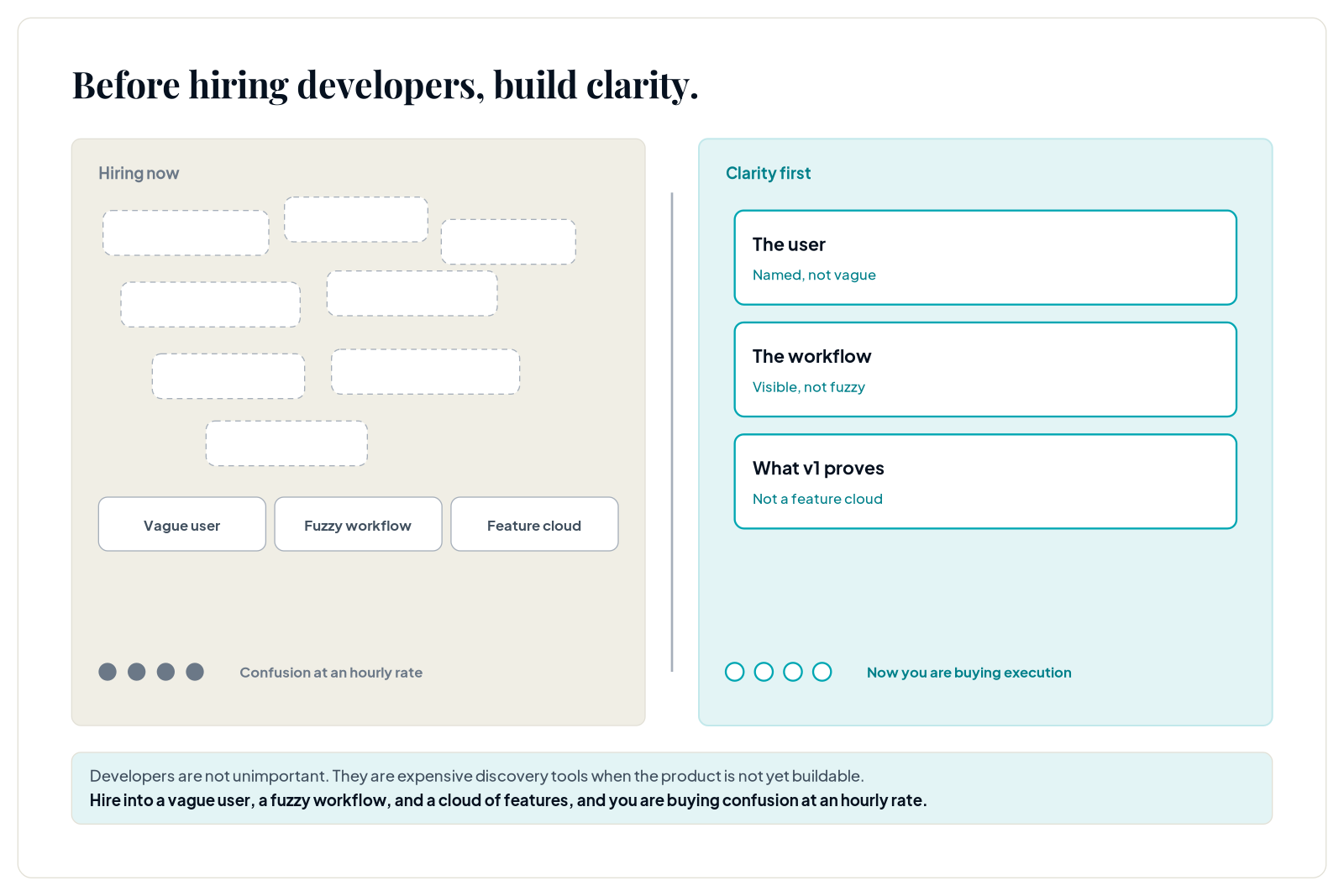
Most founders think they need developers earlier than they actually do.
That does not mean developers are unimportant. It means developers are expensive discovery tools when the founder has not done the work to make the product buildable.
If you hire developers while the user is vague, the workflow is fuzzy, and the first version is still a cloud of features, you are not buying execution. You are buying confusion at an hourly rate.
Before hiring developers, build clarity.
Developers Should Build the Product, Not Discover the Product
This is the uncomfortable truth for non-technical founders: a developer can write code, but they cannot magically resolve the business decisions you have avoided.
They can ask better questions. A good team will absolutely challenge weak scope. That said, developers should not be responsible for discovering who the product is for, what pain is urgent, what the first workflow looks like, or what the MVP must prove.
Those are founder decisions.
The fundamental difference here is between being developer-ready and being development-ready. Developer-ready means you have found someone who can code. Development-ready means you have a clear enough product loop that a team can estimate, design, build, test, and launch without redefining the company every week.
Most early founders are trying to solve the first problem when they actually have the second problem.
Build a One-Page Problem Brief
The first thing to build is not a feature list. It is a one-page problem brief.
This should explain who the first user is, what painful problem they have, how they solve it today, why the current solution is broken, and what outcome they want badly enough to change behavior.
If this sounds basic, that is exactly why it matters. A vague brief creates vague software. A sharp brief makes every later decision easier.
For example, "we are building a platform for small businesses" is almost useless. "We are helping salon owners stop losing WhatsApp enquiries by turning messages into bookings, reminders, payments, and follow-ups" is a buildable direction.
Specificity is not a writing exercise. It is a scoping tool.
Build a Customer Evidence Folder
The next thing to build is evidence.
Not encouragement. Not compliments. Evidence.
Weak validation sounds like, "People said the idea is interesting." Stronger validation sounds like, "Twelve clinic owners described the same booking problem, four shared screenshots of missed follow-ups, and two asked if they could use the first version next month."
Your evidence folder can be simple. It can include interview notes, call recordings, waitlist data, screenshots of manual workarounds, messages from interested users, paid pilot commitments, or examples of the spreadsheets people already use.
This matters because developers do not need a founder's excitement. They need the reality the product is supposed to serve.
Build the Manual Version First
If you cannot run the workflow manually, you probably cannot scope it properly.
That might sound harsh, but it saves founders from a lot of wasted development. A manual version forces you to see the real steps behind the product: what users send, what they misunderstand, what needs review, what can be automated later, and where the founder still has to make judgment calls.
The manual version might be a spreadsheet, WhatsApp flow, Airtable base, form, Notion page, concierge service, or founder-operated workflow. It does not need to be elegant. It needs to reveal the truth.
For a marketplace, this could mean onboarding vendors manually before building a vendor portal. For an AI diagnostic product, it could mean generating reports with a human review layer before building a full AI system. For a booking product, it could mean processing the first enquiries manually before automating slot logic.
Manual work is not the opposite of product. At the beginning, it is often the fastest path to product clarity.
Build the First Workflow Map
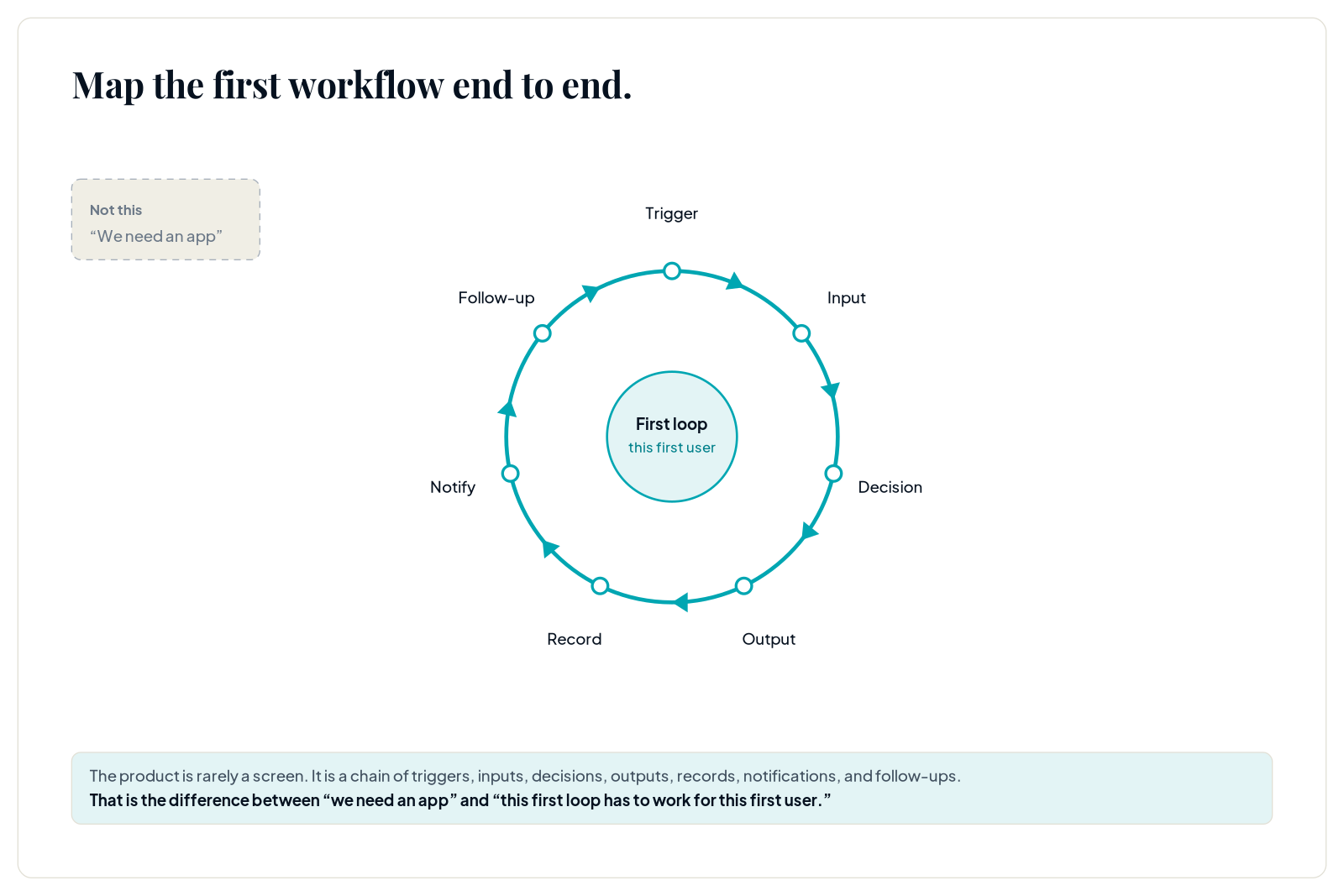
Once you understand the problem and have some evidence, map the first workflow end to end.
This is where a lot of founders finally see what they are actually asking developers to build. The product is rarely just a screen. It is a chain of triggers, inputs, decisions, outputs, records, notifications, and follow-ups.
A useful workflow map answers practical questions. What starts the process? Who takes the first action? What information is required? What decision happens next? What output does the user expect? What does the admin or founder need to see? What happens if something fails? What should be tracked after launch?
This is not busywork. It is the difference between saying "we need an app" and saying "we need this first loop to work for this first user."
Build a Prototype Before You Build Software
A prototype is not just a pretty Figma file. A good prototype tests whether the product makes sense before engineering time gets involved.
Paper sketches can work. Clickable wireframes can work. A simple no-code flow can work. The format matters less than the learning.
The prototype should help you answer questions like: does the user understand what to do, where do they hesitate, what information do they expect, what feels unnecessary, and where does the workflow break?
That said, founders can overdo this too. A beautiful prototype with no customer evidence is still theatre. The goal is not to impress people with polish. The goal is to expose confusion before it becomes code.
Build a Launch-Critical Feature List
Only after the user, evidence, manual workflow, and prototype are clear should you build the first feature list.
Even then, the list should not be every feature you can imagine. It should be launch-critical only.
A useful way to sort features is simple: build now, keep manual, defer. Build now means the MVP cannot prove its core outcome without it. Keep manual means the step matters, but automation can wait. Defer means the feature may be valuable later, but it does not belong in the first proof window.
This is where founders need discipline. Dashboards, referral systems, multi-role permissions, complex AI automation, mobile apps, subscriptions, deep integrations, and advanced analytics can all sound important. Some may become important. But if they do not help prove the first loop, they are not version one.
The first build should prove value, not imitate the final roadmap.
Build the Out-of-Scope List
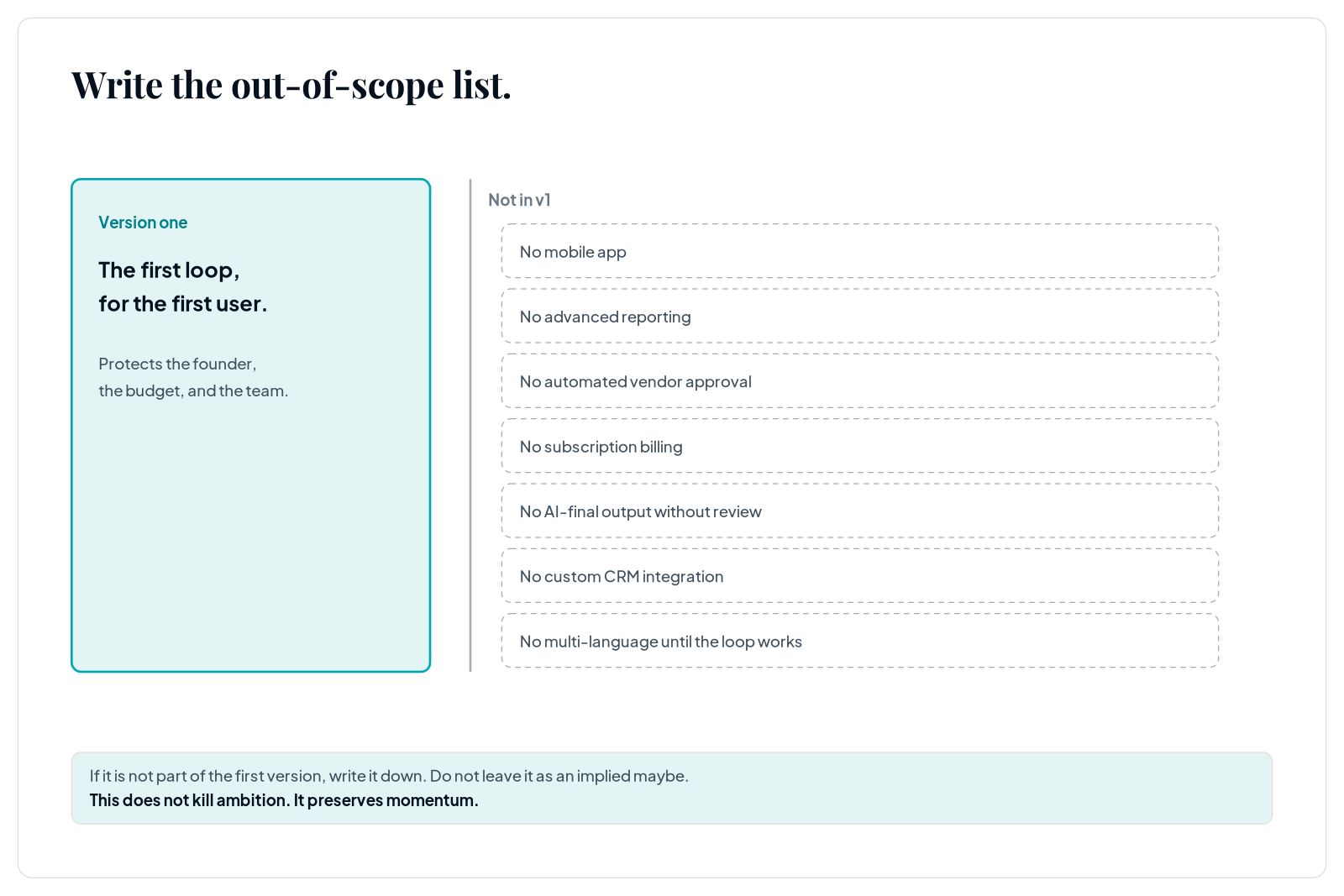
The out-of-scope list is one of the most underrated things a founder can build before hiring developers.
It protects the founder, the budget, and the development team. It also forces honesty. If something is not part of the first version, write it down. Do not leave it floating as an implied maybe.
For example: no mobile app in version one, no advanced reporting, no automated vendor approval, no subscription billing, no AI-generated final outputs without human review, no custom CRM integration, no multi-language release until the first workflow works.
This does not kill ambition. It preserves momentum.
Build an Appetite, Not Just a Budget
Founders often ask developers for quotes before deciding what the first version is worth. This is backwards.
A better starting point is appetite: how much time, money, and founder attention is this proof worth right now?
If you decide the first proof is worth four to six weeks, the scope has to fit that window. If the budget supports a focused MVP but not a full platform, the product has to be shaped accordingly. This makes trade-offs concrete instead of emotional.
This also explains why developer quotes vary wildly. One team is imagining a simple workflow. Another is imagining a scalable platform. Another is pricing unknown integrations, edge cases, polish, admin tools, QA, and post-launch support. If you have not defined the boundary, every quote is guessing a different product.
Build the Developer Brief
By the time you speak to developers, you should have a practical build brief.
It does not need to be a huge PRD. In fact, early-stage documents should be clear more than they are long. The brief should give a development team enough context to understand the user, workflow, constraints, first release, and definition of done.
At minimum, it should include the problem brief, customer evidence summary, workflow map, prototype link or sketches, launch-critical feature list, out-of-scope list, user roles, data objects, integration needs, admin needs, success metrics, budget appetite, timeline appetite, and open questions.
This is the moment where developers become useful. They can now challenge feasibility, simplify scope, identify hidden complexity, and turn the build into a realistic plan.
Do Not Pick the Tech Stack Too Early
A lot of founders get distracted by tech stack decisions before the product decision is clear.
React or Flutter. Custom code or no-code. Supabase or Firebase. AI agents or normal automation. These choices matter, but they are rarely the first choice.
The first choice is what proof the product needs to create.
Once that is clear, the stack becomes a consequence of constraints: timeline, budget, users, integrations, performance needs, maintainability, data sensitivity, and what has to happen after launch.
Founders without a CTO do not need to pretend they can make every technical decision upfront. They need to know enough to avoid forcing technical decisions before the business problem is clear.
Know When You Are Ready to Hire Developers
You are probably ready to hire developers when the first user is specific, the problem has evidence, the workflow is mapped, the first version has a proof target, and you can say what will not be built yet.
You are probably not ready when the idea is still broad, the product is a feature cloud, the launch audience is unclear, the founder cannot explain what stays manual, or the goal is to get a quote before making scope decisions.
The real kicker is that waiting a little longer can make the build move faster. A week spent clarifying the workflow can save weeks of development rework. A manual pilot can prevent an unnecessary feature. A prototype test can expose the missing step before the database is designed around the wrong assumption.
Going slower before development often makes the actual development process faster.
What Karao Would Build First
For Karao, the work before development is not abstract strategy. It is the practical layer that makes the build safer.
If a founder has interest, conversations, a deck, waitlist, or manual prototype, the first step is usually not a full build. It is to turn the founder's judgment and early signal into a clear product loop, scoped first version, and launch path.
Sometimes that means an MVP Clarity Sprint. Sometimes it means a clickable prototype. Sometimes it means a manual workflow audit. Sometimes it means moving directly into a Prototype-to-Launch Build because the evidence and workflow are already strong.
The point is not to delay development. It is to make sure development is aimed at the right thing.
Build Clarity First
Before hiring developers, do not build code. Build clarity.
Build the problem brief. Build the evidence folder. Build the manual version. Build the workflow map. Build the prototype. Build the launch-critical scope. Build the out-of-scope list. Build the developer brief.
Then hire developers.
At that point, you are no longer asking a team to turn ambiguity into software. You are asking them to turn a clear first product loop into something users can try, trust, and teach you from.
That is a much better use of everyone’s time and money.
Practical Next Step
If you are not sure whether you are ready to hire developers, score the basics first: first user, customer evidence, workflow clarity, proof target, budget appetite, and what can stay manual.
That is exactly where Karao’s Founder MVP path fits. If the signal is real but the build brief is fuzzy, start with an MVP Clarity Sprint. If the product loop is already clear, move into a Prototype-to-Launch Build.
The goal is simple: make the first development spend create learning, momentum, and a usable first version instead of expensive rework.