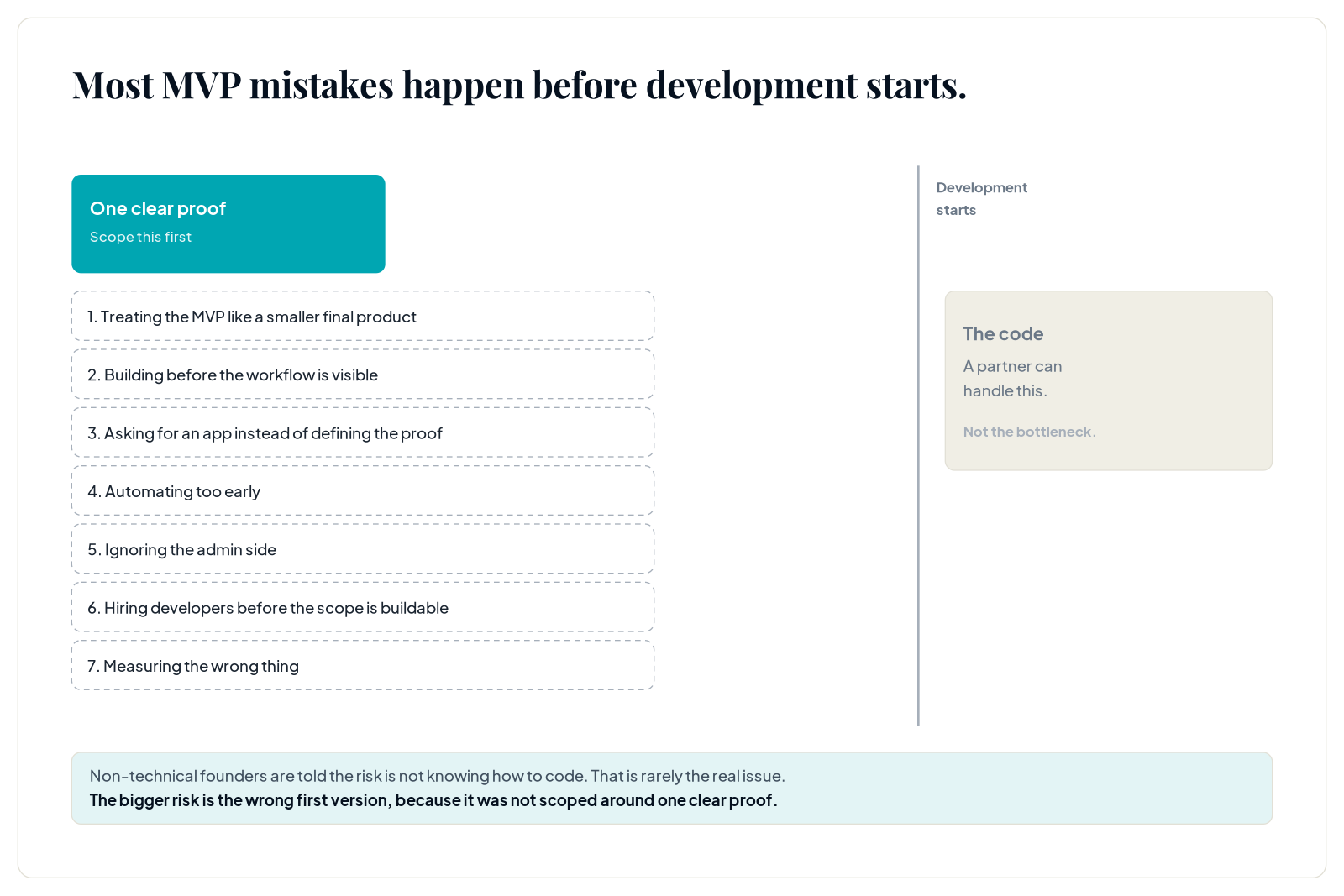
Non-technical founders are often told that their biggest risk is not knowing how to code.
That is rarely the real issue. A good technical partner can handle the code. The bigger risk is building the wrong first version because the product has not been scoped around one clear proof.
Most MVP mistakes happen before development starts.
Mistake 1: Treating the MVP Like a Smaller Final Product
A mature product has many surfaces: onboarding, dashboards, settings, notifications, roles, analytics, integrations, billing, admin, and support tools. A first MVP should not be a compressed version of all of that.
The MVP should prove the core loop. Who is the user? What problem are they trying to solve? What action must they complete? What result proves the product matters?
If the first version tries to include every future idea, the founder loses speed and clarity at the same time.
Mistake 2: Building Before the Workflow Is Visible
A founder may have a strong idea but still lack a clear workflow. That is dangerous.
Developers need to know the steps a user takes, what data is created, what decisions happen, what states exist, what exceptions matter, and what the business needs to see internally.
Without that, the team fills gaps during development. Those gaps become rework, vague estimates, confusing screens, and features that do not connect.
Mistake 3: Asking for an App Instead of Defining the Proof
An app is a delivery format. It is not the strategy.
The founder should first define what the MVP has to prove: that users will submit high-quality requests, pay for a workflow, complete onboarding, return weekly, invite suppliers, book appointments, or place repeat orders.
Once the proof is clear, the build format becomes easier. Sometimes the right first version is a web app. Sometimes it is a form, dashboard, Airtable backend, payment flow, WhatsApp workflow, or concierge prototype.
Mistake 4: Automating Too Early
Automation looks professional, but it can hide learning.
In a first MVP, some manual work is useful. It helps the founder see customer objections, edge cases, support needs, and operational costs. The trick is to keep manual work intentional instead of invisible.
Manual fulfilment can be fine. Manual approvals can be fine. Manual onboarding can be fine. But payment status, user state, and core workflow progress should be visible and reliable.
Mistake 5: Ignoring the Admin Side
Founders often think only about the customer experience. But the internal view is where the business learns.
The MVP should show users, requests, orders, payments, statuses, support issues, and conversion points. Without that view, the founder cannot understand what is happening after launch.
A beautiful customer screen with no operator visibility creates a weak MVP.
Mistake 6: Hiring Developers Before the Scope Is Buildable
Developers can build when the problem, workflow, constraints, and first proof are clear. They cannot rescue a vague product by guessing strategy through code.
Before hiring, the founder should have a clear user, use case, core loop, first release boundary, manual workaround list, data model, success metric, and launch path.
This does not require a CTO. It requires product clarity.
Mistake 7: Measuring the Wrong Thing
A launch is not proof by itself. A waitlist is not proof by itself. Signups are not always proof either.
The MVP should be measured against the behavior that matters. Did users complete the core action? Did they pay? Did they come back? Did the workflow reduce manual work? Did the business learn why customers drop off?
If the metric is too shallow, the MVP can look successful while teaching the founder very little.
What Karao Would Scope First
Karao would start by turning the idea into a buildable first version. That means identifying the target user, problem, core workflow, must-prove behavior, manual boundaries, first-release feature set, and operational view.
The goal is not to make the MVP impressive. The goal is to make it testable.
A founder does not need to become technical before building. But they do need enough product discipline to avoid paying developers to discover the product strategy inside the codebase.
Practical Checklist
Before development, write down the user, the problem, the core loop, the first proof, the minimum feature set, the manual workarounds, the admin view, the success metric, and the launch audience.
If any of those are vague, scope the MVP before hiring the build team.