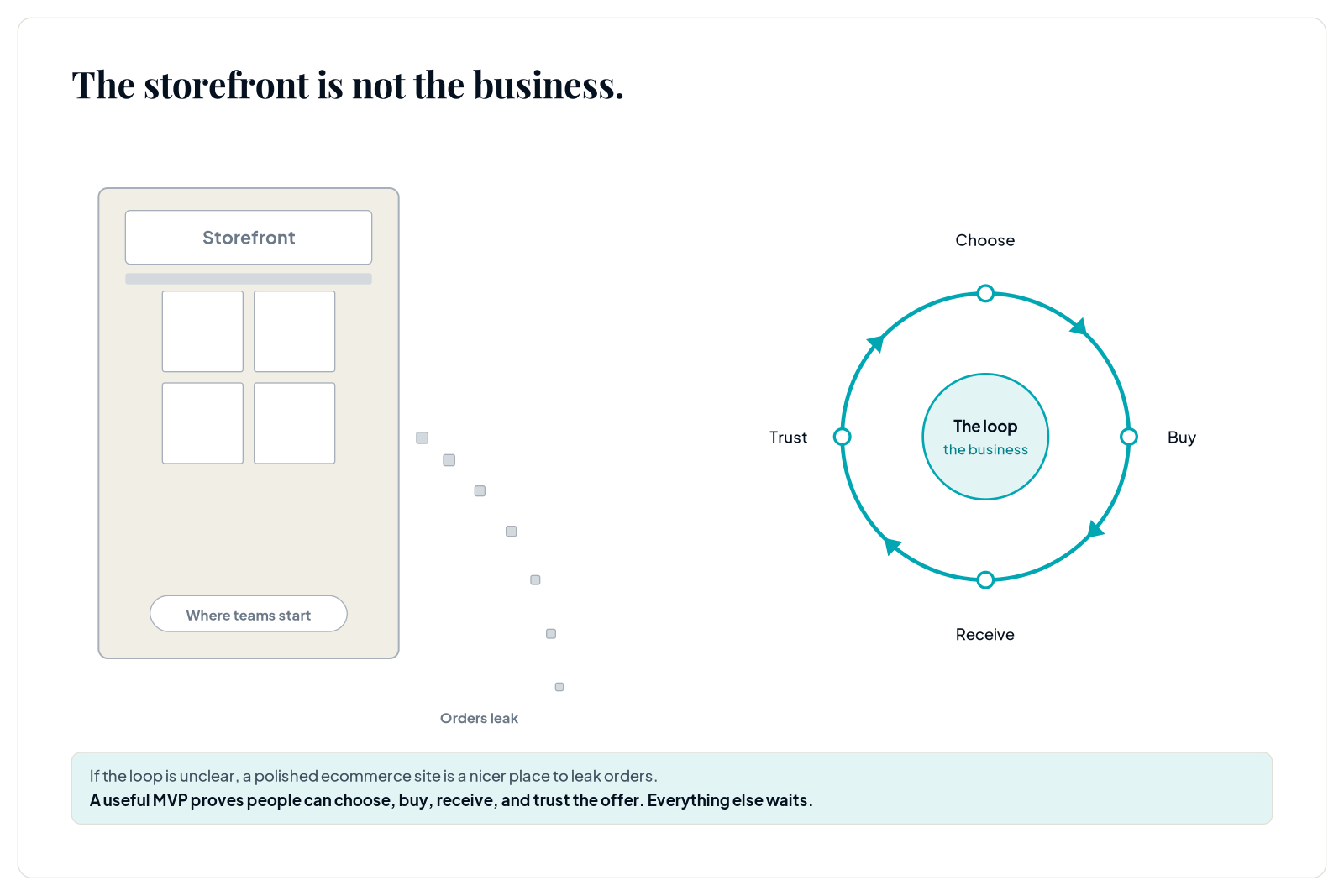
Many commerce MVPs fail because the team starts with the wrong object. They start with the storefront.
The storefront matters, but it is not the business. The business is the loop that moves a customer from product discovery to order, payment, fulfilment, support, and repeat purchase. If that loop is unclear, a polished ecommerce site simply gives the business a nicer place to leak orders.
A useful commerce MVP proves that people can choose, buy, receive, and trust the offer. Everything else is secondary until that path works.
Do Not Begin With Features
Founders often begin by listing features: product pages, filters, carts, coupons, wallet, loyalty, reviews, dashboards, delivery integrations, and admin panels. That list feels productive because it resembles the mature platforms customers already use.
But a first commerce build does not need to imitate Amazon, Shopify, or Swiggy. It needs to prove one repeatable buying path for one specific customer segment. The early question is not, "What can customers eventually do?" The better question is, "What has to be true for the first 100 orders to move cleanly without the founder manually saving every sale?"
That usually reduces the MVP sharply. You need a clear catalogue, dependable availability, a simple order path, visible payment status, a fulfilment process, and a way to handle customer questions. The rest can wait.
Start With the Commerce Loop
Map the loop before choosing the tool. The loop should answer seven questions.
What is being sold? Who is buying it? How does the customer choose the right item? How is stock or availability confirmed? How does the customer pay? How does the order get delivered or completed? What happens after the order?
If those questions are not answered, the MVP is not scoped yet. It is only decorated.
For a catalogue seller, the first loop might be WhatsApp enquiry, curated catalogue, payment link, fulfilment sheet, delivery update, and reorder prompt. For a D2C founder, it might be a small Shopify catalogue, checkout, manual fulfilment, support inbox, and customer cohort tracker. For a service-commerce hybrid, it may be productized packages, booking slot, payment, intake form, delivery workflow, and follow-up.
Choose the Smallest Real Channel
A commerce MVP does not need every channel. It needs the channel where buying intent already exists.
If customers are already enquiring on WhatsApp or Instagram, the first version may not need a full web app. If search demand is clear, a lean store may make sense. If the product requires consultation, the MVP may need a guided order flow instead of a self-serve cart.
The channel choice should follow evidence, not aspiration. A founder with a waitlist should build the purchase path for that list. A retailer with daily WhatsApp orders should systemize WhatsApp commerce before building a marketplace. A premium seller should reduce buyer uncertainty with selection help, not add hundreds of products.
Define What Must Be Manual
The best commerce MVPs are not fully automated. They are deliberately manual in the places where the business is still learning.
Manual fulfilment can be fine. Manual customer support can be useful. Manual merchandising can teach the founder which products convert. Manual stock checks may be acceptable for the first few weeks if order volume is low.
But some things should not remain invisible. Payment status should be visible. Order status should be visible. Customer details should be captured. Catalogue rules should be clear. If the founder has to scroll chats, screenshots, and spreadsheets to know whether an order is paid and ready to ship, the MVP is not operationally ready.
Build the Operator View Early
Most teams overfocus on the customer screen and underbuild the operating screen.
For commerce, the operator view is where the business survives. It should show new orders, payment status, fulfilment status, customer contact, exceptions, and next actions. This does not have to be a custom admin panel on day one. It can be a structured database, Shopify admin, Airtable, a CRM, or a lightweight dashboard.
What matters is that the team can run the business without asking the founder to remember everything. A good MVP gives the customer a simple way to buy and gives the operator a simple way to deliver.
Use Automation After the Flow Is Known
Automation is tempting in commerce because repetitive work appears everywhere: confirmations, delivery messages, payment reminders, abandoned carts, stock alerts, support replies, and reorder prompts.
The trap is automating before the rules are stable. If the catalogue is messy, stock rules are unclear, payment confirmation is inconsistent, and fulfilment status is not updated, automation will accelerate confusion.
First make the human process visible. Then automate the stable parts: payment confirmation, order notifications, standard support replies, follow-up reminders, and repeat purchase prompts.
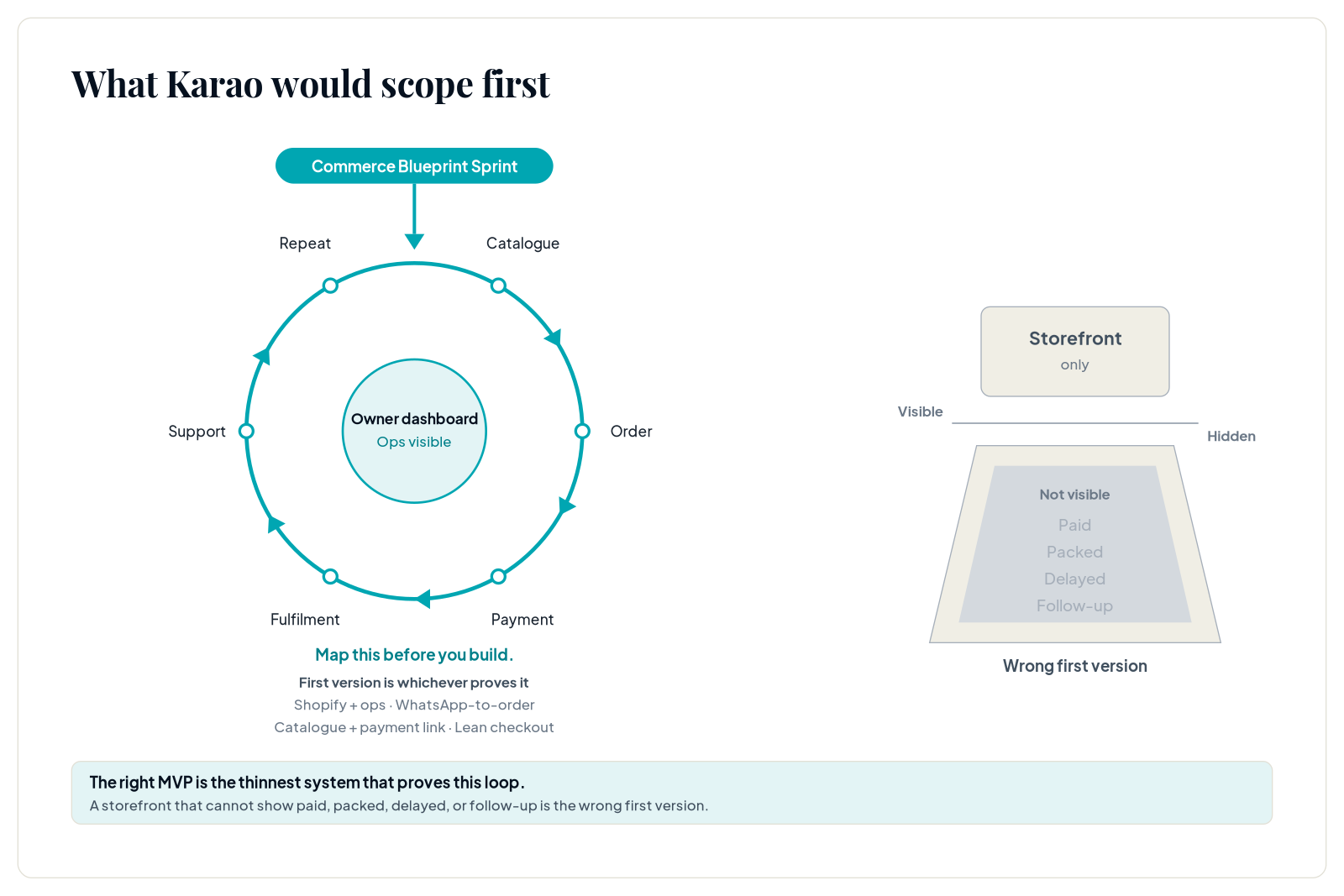
For a commerce MVP, Karao would start with a Commerce Blueprint Sprint before deciding the build. The sprint would map the catalogue, order path, payment method, fulfilment flow, customer support, repeat purchase loop, and owner dashboard.
The output should be a buildable first version, not a generic ecommerce wish list. In some cases, that is a Shopify build with custom operating logic. In others, it is a WhatsApp-to-order system, a catalogue plus payment-link workflow, or a lean web checkout connected to fulfilment.
The right MVP is the one that proves the buying loop and makes operations visible. The wrong MVP is the one that launches a storefront while the business still cannot tell which orders are paid, packed, delayed, or worth following up.
Practical Checklist
Before building, define the first product set, the first customer segment, the primary sales channel, the order status stages, the payment confirmation rule, the fulfilment owner, the customer support path, and the repeat purchase trigger.
If those decisions are clear, the MVP can stay lean. If they are not, no platform choice will save the build.